As mentioned in the last post, my tomato plants have become monsters. They are setting fruit like crazy, especially the Juliette, which is pretty typical. There are a couple starting to turn red, I am very excited. My zucchini seems to be luring me into a sense of complacency. There are baby fruits that aren't growing and I think the plant needs more water but really, I haven't had a single fruit off that plant. I doubt I will be planting Patio Star again next year. All my other squash are making fruits. It looks like I am going to have a bunch of butternut squash this year, a great victory over last year, I didn't get a single one last season. I've harvested my garlic, moving it all to the edges of the beds has made it so I could find it when it was time to collect. It is being stored in the basement so I won't be needing to buy any for a while.
The purple bed is cruising along, there isn't a lot to look at yet, I didn't want to overfill the bed this year. There is a curious thing though, the bag of mixed purple gladiolus seem to be all a dark magenta. It's a really pretty color and I like it but, it was not what I was expecting. It was a ten dollar bag of gladiolus bulbs I got from Home Depot so, go figure.
Monday, August 7, 2017

Tuesday, June 27, 2017
Stella!!
Something or some one has taken all the cherries off my Stella cherry tree. I did get to eat 2 of them and they were almost all perfectly ripe. I went to go grab more off the tree yesterday and they were gone. I did get to feed the S.O. 2 as well and he now knows why I was so very particular about which kind of cherry I wanted. On the upside for the tree, since it did produce fruit this year (last year there was nothing), I will let it live.
in veggie garden updates, my tomatoes are now monsters. I am pruning the plants so when the tomatoes are ready, I can actually find them.
The extra start from the wall o waters was well worth it. Everything else is doing pretty well, I think I finally conquered the over planting urge. The only plant that is not thriving is the zucchini, I'm sure in a month it will be giant and I will be ding dong ditching zucchini on doorsteps.
 |
| I guess they left a couple fruits behind |
in veggie garden updates, my tomatoes are now monsters. I am pruning the plants so when the tomatoes are ready, I can actually find them.
 |
| The upgraded cages were also a good idea |
 |
| I found itty bitty fruit on this one, huzzah! |
Sunday, May 28, 2017
2017 Veggie round up
My veggie planting is complete, so I thought it was time to write about this year's planned crops. I have also doubled the number of raised garden beds again, so now I have 4 beds. I may actually not overcrowd my planters this year. There is laughter in my own head over that. Of course, I am going to overcrowd my planters, it's what I do. I did have some slug problems last year, they seem to be more under control at the moment. I did buy some Sluggo and added that to my anti-slug arsenal to help keep them from being a problem. There was also a problem with the soil I bought for the new planter last year. It was hot, or rather, it seems the organic material in it was still breaking down which made the soil really warm. This cooked a couple of my peppers at the roots although, the eggplant loved it and grew really big. I remedied that this year by making the new planters a month before I planted anything so the soil could finish breaking down before I put anything in it. It seems to have worked.
Seattle's Best Tomato- took forever to get fruit, not very tasty when I did. My search for a slicer tomato I like continues
Viva Italia Tomato- Once again, not super impressed with the flavor and the plant collapsed under it's own weight making the fruit hard to get.
Some of the peppers I tried last year- They cooked in the soil so I never got to try them.
Rosa Bianca Eggplant- Loved it last year, no one was selling it this year, going to try a different variety.
Danver Carrots- They never grew. I have the worst luck with carrots.
Sugar Pie pumpkin- Good pumpkin but I found another more exciting variety for this year
Squashes- Acorn and zucchini had fewer powdery mildew issues last year so they produced more and more steadily.the butternut squash failed miserably but I am going to try them again. We eat a lot of butternut squash and being able to grow our own would be awesome.
Juliet tomato- Still my favorite variety to grow. Once again, it was a total champ
Lettuce- Gotta love being able to pick lettuce as needed in the spring.
Garlic- With 4 planters it will be much easier to keep track of the garlic so I can find it all come harvest time. I am determined to master a system for garlic, we eat a lot of it.
Hot Peppers- most cooked in the soil last year but I am going to plant them again including Satan's kiss, habenero, and jalapeno.
Onions- I wasn't planning on doing onions this year but some one at work had extra sets. I have purple, white, and a yellow.
Fennel- We tried cooking with fennel bulb this winter and ended up liking it quite a bit so I thought it was worth a try to grow it.
Basil- Saw some at the annual plant sale I go to and it isn't the Genovese that is found everywhere. This one has a smaller leaf and I am hoping it attracts less slug attention.
Black beans- Why not? We eat a lot of them and these are a bush type so they should be pretty easy to care for. As long as I figure out what to do with them post harvest they should get eaten.
Snap Peas- Already a win. I've been eating them for the past two weeks and they have been pretty easy to grow.
Radish "Sparkler"- Also already a winner, I bought this as a seed tape and it has worked great.
Kaleidoscope Carrot Collection- Carrots in a seed tape may be my ticket to carrot success. thee have actually germinated pretty well.
Ground Cherry- Looks like a small tomatillo, tastes sweet. It's hard to explain but I got to eat a couple last year and was determined to try growing it this year.
Potatoes- I am taking the plunge and trying to grow potatoes. The extra risky part is that I am growing 2 of the varieties in cardboard boxes. I am hoping the boxes manage to keep their shape long enough for this to work. I am growing Purple Majesty, Yukon Gold, and a fingerling called Makah Ozette.
Naked Bear Pumpkin- A small sugar pie type pumpkin with hull less seeds! I love roasted pumpkin seeds and with this variety I won't even have to deal with the hulls. It's a total win.
Prosperosa Eggplant- Italian variety that I have not tried before and since I couldn't find Rosa Bianca, this one will have to do.
i am also testing out another set of paste and slicing tomatoes, if they do well I will repeat them.
Things from last year I am not replanting
Bush beans- I really like green beans, I do. They grew great, no big problems other than some slug attacks. The thing is, in the height of grilling season, I don't really want to eat them. Green beans are a veggie I associate more with fall and cooler weather. They just didn't get eaten enough to grow them again.Seattle's Best Tomato- took forever to get fruit, not very tasty when I did. My search for a slicer tomato I like continues
Viva Italia Tomato- Once again, not super impressed with the flavor and the plant collapsed under it's own weight making the fruit hard to get.
Some of the peppers I tried last year- They cooked in the soil so I never got to try them.
Rosa Bianca Eggplant- Loved it last year, no one was selling it this year, going to try a different variety.
Danver Carrots- They never grew. I have the worst luck with carrots.
Sugar Pie pumpkin- Good pumpkin but I found another more exciting variety for this year
Things I am planting again this year
Collard greens- They love the north side of the house and they are in full bloom right now. I bought some to replace the ones that are flowering right now.Squashes- Acorn and zucchini had fewer powdery mildew issues last year so they produced more and more steadily.the butternut squash failed miserably but I am going to try them again. We eat a lot of butternut squash and being able to grow our own would be awesome.
Juliet tomato- Still my favorite variety to grow. Once again, it was a total champ
Lettuce- Gotta love being able to pick lettuce as needed in the spring.
Garlic- With 4 planters it will be much easier to keep track of the garlic so I can find it all come harvest time. I am determined to master a system for garlic, we eat a lot of it.
Hot Peppers- most cooked in the soil last year but I am going to plant them again including Satan's kiss, habenero, and jalapeno.
New plants to try this year
Red orach- already a failure, I planted the seeds when I planted the radishes and carrots this year and they never appeared. I can't find much on their germination preferences either so I don't know how to get it to work.Onions- I wasn't planning on doing onions this year but some one at work had extra sets. I have purple, white, and a yellow.
Fennel- We tried cooking with fennel bulb this winter and ended up liking it quite a bit so I thought it was worth a try to grow it.
Basil- Saw some at the annual plant sale I go to and it isn't the Genovese that is found everywhere. This one has a smaller leaf and I am hoping it attracts less slug attention.
Black beans- Why not? We eat a lot of them and these are a bush type so they should be pretty easy to care for. As long as I figure out what to do with them post harvest they should get eaten.
Snap Peas- Already a win. I've been eating them for the past two weeks and they have been pretty easy to grow.
Radish "Sparkler"- Also already a winner, I bought this as a seed tape and it has worked great.
Kaleidoscope Carrot Collection- Carrots in a seed tape may be my ticket to carrot success. thee have actually germinated pretty well.
Ground Cherry- Looks like a small tomatillo, tastes sweet. It's hard to explain but I got to eat a couple last year and was determined to try growing it this year.
Potatoes- I am taking the plunge and trying to grow potatoes. The extra risky part is that I am growing 2 of the varieties in cardboard boxes. I am hoping the boxes manage to keep their shape long enough for this to work. I am growing Purple Majesty, Yukon Gold, and a fingerling called Makah Ozette.
Naked Bear Pumpkin- A small sugar pie type pumpkin with hull less seeds! I love roasted pumpkin seeds and with this variety I won't even have to deal with the hulls. It's a total win.
Prosperosa Eggplant- Italian variety that I have not tried before and since I couldn't find Rosa Bianca, this one will have to do.
i am also testing out another set of paste and slicing tomatoes, if they do well I will repeat them.
Wednesday, May 10, 2017
Purple Bed
Have I stuck to a single color? Almost. I planted a dwarf forsythia so there is a pop of yellow in early spring and a few annuals in other colors as fillers.
 |
| Dwarf Forsythia in the background Globularia cordifolia in the foreground awaiting planting |
 |
| Just planted. I will be adding to this I'm sure |
 |
| My maple, just starting to leaf out |
Tuesday, April 25, 2017
Wall o Water
If you've never heard of Wall o Waters you either live someplace with really steady and predictable spring seasons or you didn't know they exist. In short, they are used as tiny greenhouses to extend the growing season of plants. I've usually used them to give a head start to my hot season vegetables like tomatoes and peppers. Especially when I lived in eastern Colorado where the weather has always been erratic in the spring, my family used these bad boys to protect our tiny plants from frost, snow, hail and wind.They can last for a long period of time, I got a bunch from my father and I'm not even sure how long he had them.
Basic construction is that they are a tube of heavy duty plastic folded in half and sectioned off. Words to describe the construction are failing me, here is a picture instead.
They are usually either green or red, though I think my mom had ones that were clear.
So this is how they work. Each of the sections is filled part of the way up and the wall o water forms a little teepee that can be put over a small plant. When the plant outgrows the teepee the whole thing can be removed. By then, it should be warm enough outside and the plant should be big enough to handle a little wind
or the tubes can be filled all the way up which will make the wall o waters stand up like a little fortress wall. I've never done that, I think it is useful in areas where it doesn't get really warm in the summer.
When done with them for the season, dump out the water, let them dry out and they can be folded to a pretty small size to be stored away for the next year.
Seriously though, they are great little plant protectors and I can't recommend them enough
Basic construction is that they are a tube of heavy duty plastic folded in half and sectioned off. Words to describe the construction are failing me, here is a picture instead.
 |
| When unfilled, the wall o water is easy to store |
They are usually either green or red, though I think my mom had ones that were clear.
So this is how they work. Each of the sections is filled part of the way up and the wall o water forms a little teepee that can be put over a small plant. When the plant outgrows the teepee the whole thing can be removed. By then, it should be warm enough outside and the plant should be big enough to handle a little wind
 |
| Little teepee over my baby tomatoes |
 |
| Even though it hasn't been very warm out (around 50) during the day, these little guys are warm enough to keep growing |
When done with them for the season, dump out the water, let them dry out and they can be folded to a pretty small size to be stored away for the next year.
Seriously though, they are great little plant protectors and I can't recommend them enough
 |
| Bonus photo of carrot seedlings! I finally have had success in germinating carrot seeds! |
Monday, April 10, 2017
Plants people love to hate
My husband hates irises. the only reason I can find as to why is that he once owned a house where the irises in his yard never bloomed. I'm pretty sure they were planted in too much shade and never watered so yes, they never bloomed. I'm trying to change his mind as I adore irises, they come in so many colors, they are hard to kill, and they self propagate.
Over the years I have discovered that people have very strong feelings about plants. Deep loves and deep hates. I myself, detest Bacopa. It's a commonly used trailing annual with white, pink or pale blue flowers. More information can be found here Bacopa Trailing Annual. I am generally not a big fan of pale colored flowers to begin with but I hate how Bacopa smells. Especially when it needs water, it has this sour mothball odor that I hate. If it isn't obvious by now reading any of my blog entries, scent is really important to me. Bacopa happens to be a plant with a terrible odor and the color is not enough to make me like it. One of the reasons I hate Bacopa is from having thousands of them that were under my care in my horticulture classes. The greenhouse would reek of them on warmer days or when they started to dry out. One of my teachers kept telling me that one day I would appreciate their reliable blooming and easy to match colors. That day has yet to arrive.
There are plants that cause deep divides in the gardening community. Roses are one plant that I've seen people on both ends of the spectrum. Some people looovvvee roses and the amount of time and care needed for roses are not an obstacle. i have met other people who hhaaate roses and the extra demands that roses often require. Both sides have valid points and really a lot of plant hate is based off past bad gardening experiences.
I realize that a bad experience can color anything. Gardening is really no different in that respect. I acknowledge that I may never change my husband's mind on irises and I doubt I'll cange my mind over Bacopa either. It's one thing that I have to keep in mind when coming across other people's plant biases. Everyone has them and listening to the background stories on plant hatreds can reveal a lot about what some one wants in a plant.
Over the years I have discovered that people have very strong feelings about plants. Deep loves and deep hates. I myself, detest Bacopa. It's a commonly used trailing annual with white, pink or pale blue flowers. More information can be found here Bacopa Trailing Annual. I am generally not a big fan of pale colored flowers to begin with but I hate how Bacopa smells. Especially when it needs water, it has this sour mothball odor that I hate. If it isn't obvious by now reading any of my blog entries, scent is really important to me. Bacopa happens to be a plant with a terrible odor and the color is not enough to make me like it. One of the reasons I hate Bacopa is from having thousands of them that were under my care in my horticulture classes. The greenhouse would reek of them on warmer days or when they started to dry out. One of my teachers kept telling me that one day I would appreciate their reliable blooming and easy to match colors. That day has yet to arrive.
There are plants that cause deep divides in the gardening community. Roses are one plant that I've seen people on both ends of the spectrum. Some people looovvvee roses and the amount of time and care needed for roses are not an obstacle. i have met other people who hhaaate roses and the extra demands that roses often require. Both sides have valid points and really a lot of plant hate is based off past bad gardening experiences.
I realize that a bad experience can color anything. Gardening is really no different in that respect. I acknowledge that I may never change my husband's mind on irises and I doubt I'll cange my mind over Bacopa either. It's one thing that I have to keep in mind when coming across other people's plant biases. Everyone has them and listening to the background stories on plant hatreds can reveal a lot about what some one wants in a plant.
Monday, March 20, 2017
Seeds!-2
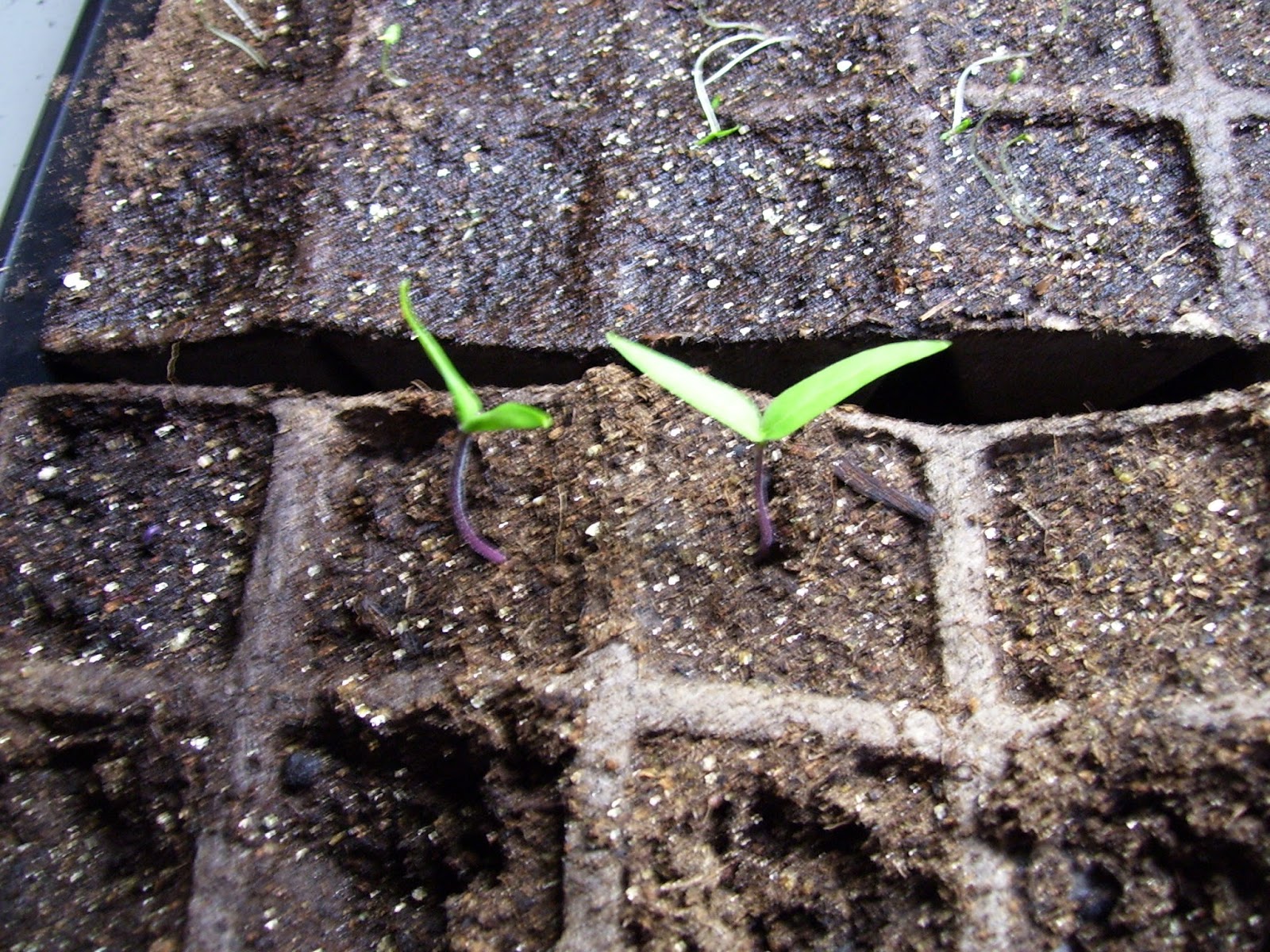
It's been a couple weeks since starting some seeds and my impatience has bitten me in the butt a little. I assumed that none of the Datura were going to germinate after about 8 days so I tossed a bunch of them outside. Now I have 4 of the little buggers coming up. One that I just noticed this morning. Maybe the ones I half buried in the mulch will appear? At least I have a couple to work with and if I get a full seedpod this summer I will get plenty to work with next year.
The hibiscus outgrew the seed starter pots basically immediately so they've been moved to larger pots. I also started another round of seeds but they didn't germinate as well. Still I just wanted a couple, so having over 10 to work with and hopefully survive makes me very happy.
The ground cherries were slow to germinate so I started another set of them. Now the first ones are putting on their first set of true leave and the second set are really spindly and will more than likely flame out. Not sure what the difference was, at any rate, I am still looking super forward to growing them this summer.
I also started some flowers called Irish Poet Tassel flowers. Fast germination gives me hope and I have a feeling they will reseed themselves in my yard. Low maintenance for the win!
I of course want to start a bunch more stuff but my space is limited and really everything else only needs a 2-3 week lead up time to going outside. Spring has sprung and I am itching to plant like crazy
 |
| Datura babies |
 |
| Hibiscus on the right |
 |
| Shiny happy Ground Cherries |
I of course want to start a bunch more stuff but my space is limited and really everything else only needs a 2-3 week lead up time to going outside. Spring has sprung and I am itching to plant like crazy
Sunday, February 26, 2017
Seeds!
 |
| Two heating pads and one grow light should be all I need this year |
 |
| A small sampling of my seed obsession |
I may have also been buying seed packets at nurseries too. I am interested in getting more specific vegetable varieties and seeds are really the best option. I want to try some new to me plants that I've never seen as transplants. I also want to better fill my garden beds with flowers and seeds are much cheaper for getting a lot of plants at once.
So far I have three different plants started, the three that need the longest lead up time before the last frost. Edible Hibiscus, Devil's Trumpet, and Ground Cherries. I am surprised the Hibiscus has been the fastest to germinate, there is little information on starting these from seed.
 |
| Hibiscus babies! |
 |
| The blank spot where the Devil's Trumpet should be |
Monday, September 19, 2016
Fall planting
It is fall, almost officially by now, and the solemn promise I made to not buy plants over the summer has ended. I more or less followed that promise. I did buy a "Brandy" rose, the only rose I really wanted for my garden and a Hibiscus called "Midnight Marvel" with purple foliage and red flowers. otherwise I resisted with all my might. Once September rolled around my personal ban ended and this also coincides with end of season sales at the local nurseries. Perennials, shrubs, and trees on sale, yes please! Fall is also a great time to plant, the roots can get a little established before winter rolls around and the plants are less stressed the next spring. Here is a great guide from Michigan no less, about fall planting. 10 Tips for planting trees and shrubs in the fall
My crowning jewel for this fall is a Shagbark Maple. the more commonly used name is Paperbark Maple but I love saying shagbark, it is a much more fun name. The scientific name is Acer griseum and it has a fantastic cinnamon colored peeling bark with a clear red fall color.
I have been waiting all summer to pick up one of these, holding out until the fall sales, when this beauty went from being $125 to $75. I wanted to buy one last year at the same sale but I didn't like the shape of the trees they had. They looked more like shrubs and I wanted to make sure that I got one that would need very little training or pruning.
The other must get this year was a clematis called "Sweet Summer Love". Some great info on it here Sweet Summer Love Clematis. It is a late blooming purple clematis that is also fragrant. This plant is right up my alley. There is a person living nearby with a white late blooming fragrant clematis and after seeing that one I hunted down this fabulous hybrid. it will also serve the purpose of covering up a gap in my neighbors chain link fence that my dogs can fit through.
I also scored some half off asters, red lupines, Hot Lips Salvia, Balloon flower, ice plant, and delphinium. The asters may have to be temporarily planted since they are to be planted on the outside of a fence that does not yet exist. The balloon flower may go up in the front in a bed I am hoping to work on in a couple weeks. Everything else, well, I haven't decided yet but I'm sure I will find space somewhere
My crowning jewel for this fall is a Shagbark Maple. the more commonly used name is Paperbark Maple but I love saying shagbark, it is a much more fun name. The scientific name is Acer griseum and it has a fantastic cinnamon colored peeling bark with a clear red fall color.
 |
| Oh, how I love that bark! |
I have been waiting all summer to pick up one of these, holding out until the fall sales, when this beauty went from being $125 to $75. I wanted to buy one last year at the same sale but I didn't like the shape of the trees they had. They looked more like shrubs and I wanted to make sure that I got one that would need very little training or pruning.
The other must get this year was a clematis called "Sweet Summer Love". Some great info on it here Sweet Summer Love Clematis. It is a late blooming purple clematis that is also fragrant. This plant is right up my alley. There is a person living nearby with a white late blooming fragrant clematis and after seeing that one I hunted down this fabulous hybrid. it will also serve the purpose of covering up a gap in my neighbors chain link fence that my dogs can fit through.
I also scored some half off asters, red lupines, Hot Lips Salvia, Balloon flower, ice plant, and delphinium. The asters may have to be temporarily planted since they are to be planted on the outside of a fence that does not yet exist. The balloon flower may go up in the front in a bed I am hoping to work on in a couple weeks. Everything else, well, I haven't decided yet but I'm sure I will find space somewhere
 |
| Some more of my goodies |
Saturday, August 27, 2016
Veggie update, or what to do with all the zucchini
The veggie garden is cruising along, the tomatoes are finally turning, the green beans are producing nicely, and the zucchini is under control. There is no other way of describing how my zucchini plant is politely producing two fruits a week. My plant also had an aphid infestation while I was away(more on that another day), so it is a little slow for a zucchini plant. Though my plant is under producing this year, I have a growing stockpile of interesting recipes to use zucchini. Zucchini bread is the classic but honestly, I've never been big on it. I'd rather do banana bread or rhubarb bread and let the zucchini get used in something a little less expected. Here is a list of my favorite recipes along with links, not necessarily the same that I use, but as close as I can get.
Lebanese Egg Fritters- eggy and delicious. As an added bonus these are a good way to use up some fresh mint
Zucchini and Sweet Pepper Refrigerator Pickles- quick pickles without needing cucumbers is a win. These are great on sandwiches or burgers.
Zucchini Mock Apple Pie- Tastes like apple pie but with only zucchini. A great thing to take to a potluck to blow peoples minds.
Calabacitas con Elote With tomatoes in my family, without tomatoes for my hubby. Either way it makes a nice side dish for chicken and things
Summer Squash Pizza Granted, this one I've only made once, but it was really good and goes through a lot of zucchini. I will be making it again
I have also heard of people drying out zucchini and using it as firewood. I cannot find any sources that talk about doing this so maybe this is an old wives tale.
Lebanese Egg Fritters- eggy and delicious. As an added bonus these are a good way to use up some fresh mint
Zucchini and Sweet Pepper Refrigerator Pickles- quick pickles without needing cucumbers is a win. These are great on sandwiches or burgers.
Zucchini Mock Apple Pie- Tastes like apple pie but with only zucchini. A great thing to take to a potluck to blow peoples minds.
Calabacitas con Elote With tomatoes in my family, without tomatoes for my hubby. Either way it makes a nice side dish for chicken and things
Summer Squash Pizza Granted, this one I've only made once, but it was really good and goes through a lot of zucchini. I will be making it again
I have also heard of people drying out zucchini and using it as firewood. I cannot find any sources that talk about doing this so maybe this is an old wives tale.
Saturday, July 2, 2016
Pollinator gardens
I know that I am a small voice in a very large chorus calling for providing more food and habitat for pollinators in the garden. At this point most gardeners are very concerned about colony collapse of honey bees and about planting milkweed for butterflies. Gardeners are also very aware of the shrinking habitats of many other beneficial insects. In my own yard and even neighborhood I see very few flying insects. Living in an urban/suburban where everyone has a yard nearly full of grass, there isn't enough for insects to eat and few places for them to nest. The other part of it is though there is a lot of press in the USA about the disappearance of honey bees, honey bees aren't native to the new world. They were brought over from Europe centuries ago. There are lots of native bees to the United States, thousands of different types that live all over North America. Here is a great list of some of them Native Bees of North America, they like different flowers and a lot of them are solitary. My favorites are the solitary bumblebees that are ground nesting and squash bees. Squash bees are adorable, sometimes I find them sleeping in squash flowers in the morning, waiting for the sun to warm them back up. Solitary bumblebees are also adorable, though I usually find them after scaring them awake.
I will be making my yard more insect friendly. This benefits myself, by making my fruit trees and vegetable garden more productive. It is also good for the environment. Here are the vows I am making to make my yard a more diverse ecosystem.
1. I vow to leave my yard a little higher and not try to remove all the weeds from it. Part of me would be totally fine with never mowing my yard but I think I can be ticketed by the city if I don't. When I mow my yard a little on the long side, I keep more of the clover flowers. In fact I think I am going to seed more clover into my yard, I love seeing the flowers all summer and of course, the flowers are frequented by bees. Leaving it a little taller also makes it stay green a little longer into summer. It is a pretty common practice to not water lawns in my city during the dry summers. taller grass also eaves more places for insects to hang out, like spiders and ants. By not trying to take out all the dandelions, early emerging bees, like mason bees, get something to snack on in my yard. If they come for the dandelions, they might stay for cherry trees that are blooming about the same time. In the summer, nipplewort throws up their flowers and can lure more bees in my yard.
2. Next year I am getting mason bees and making a bee hotel. There are 150 types of Mason bees in North America. They vary by region but all are solitary and they all nest in tunnels. You can buy mason bee larva to release into your yard and they can find their own places to nest, however, they may not settle down nearby. So building a bee hotel for them is a good idea. Most mason bees are active early in the year so I must make sure there are things to eat in early spring. I have that partially covered by early blooming fruit trees and dandelions but I will need to look into it more. They also need mud to repack their tunnels so a bare patch in the yard will be a good plan. Here is a good page on making and managing places for mason bees Attract Mason Bees.
3. Plant some native plants to bring native insects to my yard. The Xerces Society has some amazing lists broken down by narrow regions through the US here Pollinator Plant Lists. I fully recommend these lists since they are really detailed. I already know I want goldenrod and asters, the combination late in the year is really pretty. I also have my eye on some vine maple cultivars, as mentioned in a previous post. Planting natives in my yard is already in my mind because I work with native plants currently so I can see how they look in combination and get ideas for plantings. Plus I know where to get the native plants I like, which nursery gets and grows what plants. There are advantages to working in the plant industry when planning and designing gardens.
4. Encourage my neighbors to do similar things. No pollinator garden is an island and making a great garden in only my yard will be good, but it can get better. Getting a few of my neighbors to plant some bee friendly flowers will give the bees more places to live. Some of this will be by talking to them directly about what I am doing and why. A majority of the work will be showing how pretty and vibrant my yard will be. Nothing encourages gardening activity like having a really nice garden in the neighborhood. Maybe it is jealousy, maybe it is a curb appeal thing but, one really nice flower filled yard can encourage other people to garden too. Plus, I will be able to divide out plants and gift them around the block. It may be a little devious but preaching at people about the importance of pollinator habitat can backfire. nobody likes being lectured at, most people like free low maintenance plants.
5. Using a minimal amount of herbicide/pesticides in my yard. I garden mostly organically anyway so this will be easy for me. I only use herbicide when there is no other way of controlling the weed. Pesticides are saved for when I see damage that is beyond what I can stand. Even then I follow all the guidelines for the herbicide/pesticide and use the appropriate herbicide/pesticide for the job.
I know that this will not all happen overnight. This will be a multiyear process that I will be committing to. I will be celebrating my victories through extra garden bounty and by watching the increase in activity in my yard.
I will be making my yard more insect friendly. This benefits myself, by making my fruit trees and vegetable garden more productive. It is also good for the environment. Here are the vows I am making to make my yard a more diverse ecosystem.
1. I vow to leave my yard a little higher and not try to remove all the weeds from it. Part of me would be totally fine with never mowing my yard but I think I can be ticketed by the city if I don't. When I mow my yard a little on the long side, I keep more of the clover flowers. In fact I think I am going to seed more clover into my yard, I love seeing the flowers all summer and of course, the flowers are frequented by bees. Leaving it a little taller also makes it stay green a little longer into summer. It is a pretty common practice to not water lawns in my city during the dry summers. taller grass also eaves more places for insects to hang out, like spiders and ants. By not trying to take out all the dandelions, early emerging bees, like mason bees, get something to snack on in my yard. If they come for the dandelions, they might stay for cherry trees that are blooming about the same time. In the summer, nipplewort throws up their flowers and can lure more bees in my yard.
2. Next year I am getting mason bees and making a bee hotel. There are 150 types of Mason bees in North America. They vary by region but all are solitary and they all nest in tunnels. You can buy mason bee larva to release into your yard and they can find their own places to nest, however, they may not settle down nearby. So building a bee hotel for them is a good idea. Most mason bees are active early in the year so I must make sure there are things to eat in early spring. I have that partially covered by early blooming fruit trees and dandelions but I will need to look into it more. They also need mud to repack their tunnels so a bare patch in the yard will be a good plan. Here is a good page on making and managing places for mason bees Attract Mason Bees.
3. Plant some native plants to bring native insects to my yard. The Xerces Society has some amazing lists broken down by narrow regions through the US here Pollinator Plant Lists. I fully recommend these lists since they are really detailed. I already know I want goldenrod and asters, the combination late in the year is really pretty. I also have my eye on some vine maple cultivars, as mentioned in a previous post. Planting natives in my yard is already in my mind because I work with native plants currently so I can see how they look in combination and get ideas for plantings. Plus I know where to get the native plants I like, which nursery gets and grows what plants. There are advantages to working in the plant industry when planning and designing gardens.
4. Encourage my neighbors to do similar things. No pollinator garden is an island and making a great garden in only my yard will be good, but it can get better. Getting a few of my neighbors to plant some bee friendly flowers will give the bees more places to live. Some of this will be by talking to them directly about what I am doing and why. A majority of the work will be showing how pretty and vibrant my yard will be. Nothing encourages gardening activity like having a really nice garden in the neighborhood. Maybe it is jealousy, maybe it is a curb appeal thing but, one really nice flower filled yard can encourage other people to garden too. Plus, I will be able to divide out plants and gift them around the block. It may be a little devious but preaching at people about the importance of pollinator habitat can backfire. nobody likes being lectured at, most people like free low maintenance plants.
5. Using a minimal amount of herbicide/pesticides in my yard. I garden mostly organically anyway so this will be easy for me. I only use herbicide when there is no other way of controlling the weed. Pesticides are saved for when I see damage that is beyond what I can stand. Even then I follow all the guidelines for the herbicide/pesticide and use the appropriate herbicide/pesticide for the job.
I know that this will not all happen overnight. This will be a multiyear process that I will be committing to. I will be celebrating my victories through extra garden bounty and by watching the increase in activity in my yard.
Saturday, May 21, 2016
Slugs, for serious
slugs are a nuisance and last year I managed not to have any major damage from them. I lucked out last year and they really didn't attack anything in my yard until pretty late in the summer. Even then, the slugs really only went after some of the tomatoes. This spring they have shown up in the planter box from last year pretty frequently. The puzzling thing is that other than starting off by eating down one of the lettuces, they've really ignored their usual food sources. For some reason I still don't understand, they are eating my baby squash plants.
Squash leaves are rough and bristly exactly the kind of leaf slugs don't like. The extra confounding part, there is a lettuce 6" away from the butternut squash. The slugs have barely touched it.
I've decided on a multifaceted attack on the slugs.
Beer- I have a collection of beers that I don't like very much. Beer is the age old go to for slug killing, put some in a shallow dish, bury a can of beer, or just leave a half filled bottle tucked next to the plants. The slugs crawl in, get drunk, and drown. This way they die happy and I have a use for all the beer that I don't really like.
Diatomaceous earth- This is fossilized plankton for lack of a better description. It is a very fine powder that can be sprinkled around plants. The fossils have a high silica content which makes them very sharp on a microscopic level. It is very uncomfortable for slugs to go across and had the advantage of discouraging other pests too. It does need to be reapplied every few weeks be careful about breathing it in. Here is a full article on it's uses in the garden http://www.gardeningknowhow.com/plant-problems/pests/pesticides/diatomaceous-earth-insect-control.htm
Picking them off- If I get outside early enough in the morning, I have been pulling the little buggers off my plants and depositing them in the beer. I do throw some out in the street in the hopes they are run over or they go away. I'm sure they just head back toward those sweet sweet squash plants they seem to like so much.
I'm hoping that in a couple of weeks the squash plants will be big enough and bristly enough the slugs will no longer be interested in them. Of course by then the beans will be out of the ground so the slugs might turn their attention that way. This should be interesting.
 |
| my poor suffering Butternut |
 |
| The lettuce is right there, why do they keep eating the squash? Why?! |
Beer- I have a collection of beers that I don't like very much. Beer is the age old go to for slug killing, put some in a shallow dish, bury a can of beer, or just leave a half filled bottle tucked next to the plants. The slugs crawl in, get drunk, and drown. This way they die happy and I have a use for all the beer that I don't really like.
Diatomaceous earth- This is fossilized plankton for lack of a better description. It is a very fine powder that can be sprinkled around plants. The fossils have a high silica content which makes them very sharp on a microscopic level. It is very uncomfortable for slugs to go across and had the advantage of discouraging other pests too. It does need to be reapplied every few weeks be careful about breathing it in. Here is a full article on it's uses in the garden http://www.gardeningknowhow.com/plant-problems/pests/pesticides/diatomaceous-earth-insect-control.htm
Picking them off- If I get outside early enough in the morning, I have been pulling the little buggers off my plants and depositing them in the beer. I do throw some out in the street in the hopes they are run over or they go away. I'm sure they just head back toward those sweet sweet squash plants they seem to like so much.
I'm hoping that in a couple of weeks the squash plants will be big enough and bristly enough the slugs will no longer be interested in them. Of course by then the beans will be out of the ground so the slugs might turn their attention that way. This should be interesting.
Saturday, May 14, 2016
2016 veggie round up
Mother's Day has come, and slightly gone and for most of the northern US. this means vegetable planting time. Last year I had one raised bed for veggies and this year I added a second planter. I am not however, doubling the amount of plants. I overcrowded the one planter last year which made harvesting things like green beans very difficult. I also had some problems with powdery mildew that I want to avoid this year. I basically took the things I planted in the one planter last year and spread it out amongst the two planters.
San Marzano tomato- They are huge tomatoes but took forever to ripen and had blossom rot issues all summer long. This is partly on me, my watering early season was a little sporadic.
Poblano/Ancho chile pepper- These are never as big as what I can get in stores or from farmer's markets. I have tried these several different times and they never work out the way I want.
Kale- grew well but I also had collard greens and the collard greens were eaten more often. I may wait a year and grow these again, once I work up a good go to kale recipe.
Habanero pepper- I got them to ripen and that is all the encouragement I need to grow them again this year. Plus, we do eat a lot of spicy food and these do get used.
Satan's Kiss pepper- the name is awesome and the peppers are tasty, double win.
Rosa Bianca eggplant- I adore the purple and white Italian eggplants, they are never bitter and also never grow to manageable sizes. This was a great one for me last year, and in years past I have also liked the Listada de Gandia, though I have not been able to find starts of that one.
Collard greens- Prolific and a great easy saute side dish, they lived all winter but were getting tough towards February. The only real difference from last year is that these were planted on the north side of the house. The north side of my house still gets a good amount of sun.
Zucchini/Acorn squash- other than dealing with the spread of the powdery mildew both of these squashes did well, we ate bunches of flowers and got a decent amount of fruit off each plant.
lettuces- I don't really remember what I bought last year, I think romaine and something else. Anyway, I figured out that I can plant lettuces really close to the tomatoes and squashes and when the lettuces bolt and are done for the season, it times up pretty well with when the squashes and tomatoes explode in growth. Pull the lettuces and then there is more room for the other plants.
Silver Rose garlic- this year I planted the garlic around the edges so I can actually find them. last year, the garlic was an afterthought and was tucked under and around other veggies. When harvest time for the garlic rolled around, I couldn't find most of it. In fact, most of the garlic for this year is last years crop divided.
Viva Italia Tomato- determinate paste tomato, I am hoping to get a good batch of tomato sauce from this guy, fingers crossed.
Purple Cayenne pepper- I am such a sucker for a purple vegetable, plus the whole plant has a purple tint to it, I am very excited
Hungarian orange carrot pepper- slightly spicy and apparently good for pickling.
Topcrop bush beans- not one I've seen before, thought it would be worth a whirl.
Danver carrots- I have had some iffy luck with carrots, they rarely grow for me. I know to most people that is crazy, carrots are supposed to be really reliable. These seem somewhat foolproof, we'll see.
Butternut squash- I eat a lot of squash and buy enough butternut to justify growing my own. I wish I found a bush/semibush type, but instead I think I will train this up a trellis of some kind.
Let the season begin, I'm ready, at least I think so.
Things from last year that I am not replanting
Lemon cucumber- epicenter of my powdery mildew issues. Also as it turns out, my S.O. doesn't really like them so growing the Lemon cucumbers is a waste of time. If I did retry them, I would put the cucs further from the tomato to help prevent the powdery mildew.San Marzano tomato- They are huge tomatoes but took forever to ripen and had blossom rot issues all summer long. This is partly on me, my watering early season was a little sporadic.
Poblano/Ancho chile pepper- These are never as big as what I can get in stores or from farmer's markets. I have tried these several different times and they never work out the way I want.
Kale- grew well but I also had collard greens and the collard greens were eaten more often. I may wait a year and grow these again, once I work up a good go to kale recipe.
Things I am growing again this year
Juliet tomato- this was a champ last year, a champ. It produced lots of fruits, somewhere between large cherry tomatoes or small plum style tomatoes. I slow roasted a lot of them using this recipe http://www.rachaelraymag.com/recipes/rachael-ray-magazine-recipe-search/side-dish-recipes/roasted-tomatoes and froze them for winter use. They were also great in salads. |
| "Juliet" tomato- my favorite from last year |
Satan's Kiss pepper- the name is awesome and the peppers are tasty, double win.
Rosa Bianca eggplant- I adore the purple and white Italian eggplants, they are never bitter and also never grow to manageable sizes. This was a great one for me last year, and in years past I have also liked the Listada de Gandia, though I have not been able to find starts of that one.
Collard greens- Prolific and a great easy saute side dish, they lived all winter but were getting tough towards February. The only real difference from last year is that these were planted on the north side of the house. The north side of my house still gets a good amount of sun.
Zucchini/Acorn squash- other than dealing with the spread of the powdery mildew both of these squashes did well, we ate bunches of flowers and got a decent amount of fruit off each plant.
lettuces- I don't really remember what I bought last year, I think romaine and something else. Anyway, I figured out that I can plant lettuces really close to the tomatoes and squashes and when the lettuces bolt and are done for the season, it times up pretty well with when the squashes and tomatoes explode in growth. Pull the lettuces and then there is more room for the other plants.
Silver Rose garlic- this year I planted the garlic around the edges so I can actually find them. last year, the garlic was an afterthought and was tucked under and around other veggies. When harvest time for the garlic rolled around, I couldn't find most of it. In fact, most of the garlic for this year is last years crop divided.
 |
| Garlic in an easy to find location |
New plants to try this year
Seattle's Best Tomato- if the variety has a region specific name, I consider this a good sign. It is a slicer tomato and is indeterminate so it will keep growing and producing. I am intrigued.Viva Italia Tomato- determinate paste tomato, I am hoping to get a good batch of tomato sauce from this guy, fingers crossed.
Purple Cayenne pepper- I am such a sucker for a purple vegetable, plus the whole plant has a purple tint to it, I am very excited
Hungarian orange carrot pepper- slightly spicy and apparently good for pickling.
Topcrop bush beans- not one I've seen before, thought it would be worth a whirl.
Danver carrots- I have had some iffy luck with carrots, they rarely grow for me. I know to most people that is crazy, carrots are supposed to be really reliable. These seem somewhat foolproof, we'll see.
 |
| Crossing my fingers for these |
Let the season begin, I'm ready, at least I think so.
Monday, May 2, 2016
Touch
A truly great garden encompasses all the senses. At least that's something that is written over and over again in garden design books. It's easy to make a garden nice to look, and having an emphasis on fragrance is pretty simple too. There are whole books devoted to edible gardening as that has become trendy again in the last few years. The sense of touch however rarely gets much of a shout out in garden design other than in the context of texture. This is kind of a shame because there are a lot of plants that are fun to reach out and pet. I am a very tactile person in general and I have a habit of trying to touch everything when shopping. I am only slightly more restrained when I am at garden centers, just on the off chance what I am reaching out to pet is really delicate or a skin irritant. So far, so good, I haven't broken any plants nor have I discovered anything unpleasantly irritating. I would like to share a few of my favorites, plants to think about including in your own space to make sure you really hit all the senses
Rhododendron yakushimanum- The underside of the leaves for this rhody are soft and velvety which makes it an irresistible plant for me. There are many hybrids of this plant so keep an eye and hand out for the ones that are pink flowered, those are the softest. I have introduced many people to the underside of the leaf and little kids always get a kick out of how fuzzy it is. As an added bonus the indumentum (the fuzz) on the underside of the leaf makes it more resistant to bugs.
Deciduous Larch- the new needles for deciduous Larches are silky and smooth and soft. I used to stalk one particularly lovely larch every spring, running my hands through the branchlets outside some ones house on my way to work.If it was a long day at work, I would walk by the tree on my way home too. There are a lot of forms of Larch, from 35 foot tall, to small pendulous forms. that means there is one for every yard size.
Mexican feather grass-The name shays it all, this grass is irresistibly feathery. When I worked at a nursery I ran my hands over and through the gallon sized pots all the time. Buyer be forewarned though, this grass is best kept contained in a pot. It is an aggressive runner and can take over a garden. However a nice planter filled with it next to a hammock or lounge chair is an excellent choice. Close enough to reach over and touch but not allowed to run rampant.
Trumpet vine - This is not much of a texture plant but like I love popping open the flowers. They are like bubble wrap. There is a popping sound and it doesn't harm the plants any just opens the flower up.
Yarrow- I hate the smell of yarrow. That said, it is a fun plant to touch. The foliage is really soft and feathery and the flowers make a bumpy cluster. I just keep my nose away from the plant.
Allium "Globemaster"- Try not to tap this flower, I dare you. There are several different Alliums that are equally satisfying to gently hit but this is the biggest and best known one.
These area few of my favorite plants for touching in the garden, here is another article with a longer list. http://www.finegardening.com/fuzzy-prickly-and-tickly-touch I know there are more fun to touch plants out there so keep your eyes and hands out for them
Rhododendron yakushimanum- The underside of the leaves for this rhody are soft and velvety which makes it an irresistible plant for me. There are many hybrids of this plant so keep an eye and hand out for the ones that are pink flowered, those are the softest. I have introduced many people to the underside of the leaf and little kids always get a kick out of how fuzzy it is. As an added bonus the indumentum (the fuzz) on the underside of the leaf makes it more resistant to bugs.
Deciduous Larch- the new needles for deciduous Larches are silky and smooth and soft. I used to stalk one particularly lovely larch every spring, running my hands through the branchlets outside some ones house on my way to work.If it was a long day at work, I would walk by the tree on my way home too. There are a lot of forms of Larch, from 35 foot tall, to small pendulous forms. that means there is one for every yard size.
Mexican feather grass-The name shays it all, this grass is irresistibly feathery. When I worked at a nursery I ran my hands over and through the gallon sized pots all the time. Buyer be forewarned though, this grass is best kept contained in a pot. It is an aggressive runner and can take over a garden. However a nice planter filled with it next to a hammock or lounge chair is an excellent choice. Close enough to reach over and touch but not allowed to run rampant.
Trumpet vine - This is not much of a texture plant but like I love popping open the flowers. They are like bubble wrap. There is a popping sound and it doesn't harm the plants any just opens the flower up.
Yarrow- I hate the smell of yarrow. That said, it is a fun plant to touch. The foliage is really soft and feathery and the flowers make a bumpy cluster. I just keep my nose away from the plant.
Allium "Globemaster"- Try not to tap this flower, I dare you. There are several different Alliums that are equally satisfying to gently hit but this is the biggest and best known one.
These area few of my favorite plants for touching in the garden, here is another article with a longer list. http://www.finegardening.com/fuzzy-prickly-and-tickly-touch I know there are more fun to touch plants out there so keep your eyes and hands out for them
Sunday, February 14, 2016
Arborist chips- A love note
As it is February, the month of love, I thought I'd share one of my own loves, arborist chips. Arborist chips are different from the mulch you buy in bags (or by the yard) from your local hardware store. The bark mulch you buy from the store is processed, usually from a single tree type and sometimes dyed to give a uniform color. Arborist chips are ground up trees, a by product of tree trimming or removal. It is made up of whatever went through the chipper that day. I adore the stuff. Let me count the ways
1. It's free, or at least, really really cheap. as it is a by product of tree work, Arborists have to figure out how to get rid of the chipped trees. If they don't have someplace to store them or a way to reuse the chips themselves, they may have to pay to dump them. So as a favor to them, you, the gardener, can offer to take the chips off their hands. You can try cold calling arborists in the area, or if you see a tree service truck in your neighborhood, ask to take the chips then. There are many municipalities around the US that offer out free mulch, usually after big windstorms. Craigslist is a good place to check for chips too. There is also a website, Chip Drop (www.chipdrop.in) , that you can use to request chips. The only draw back with Chip Drop is That it doesn't give a range of places it services, so it may be a hit or miss depending on where you live.
2. It is good for the soil. Putting down arborist chips is like having a very slow release compost/fertilizer on your garden beds. The chips will help soil drainage as they break down. And they will break down. After a couple years very little of the chip material will be left. Not a grand tragedy, just remember the first reason why Ilove Arborist chips so much, they are usually free. I know a few people that have continuously added chips as mulch over the years, and their soil was lovely. Dark, full of life, and with good drainage. I could go on but the WSU extension has a great info sheet on Arborist chips here- http://cru.cahe.wsu.edu/CEPublications/FS160E/FS160E.pdf
3. It looks nice. Arborist chips dress up a bed, making gardens look tidier and allowing the plants stand out more. Like any other top dressing for a bed, Arborist chips is used to smother out weeds. I am using chips around the foundation of my house right now to smother out the grass and everything else so I can plant there this spring. Very little has managed to grow up through the six inches of chips. The few weeds that have made it I can pop out of the ground easily.
A few notes on things people don't like about Arborist chips. They aren't uniform. each time I get arborist chips they are going to look different. Different trees, possibly from different arborists, the color of the chips as well as the size will vary. For some people that is a no go and I get that. I figure that if I pack a garden bed with interesting enough plants, no one will notice the chips. They also can come from diseased trees. There is back and forth research on whether or not Arborist chips can carry plant diseases. The WSU extension pamphlet talks about this. I worry a little about verticillium wilt coming in with the chips, my only real safeguard is to look through the chips to see if there is any maple and if there is, to look for the staining from verticillium wilt.
That is arborist chips in a nutshell, I love using them and will continue for as long as i garden. They are economical, great for the garden beds, and just make things look pretty.
1. It's free, or at least, really really cheap. as it is a by product of tree work, Arborists have to figure out how to get rid of the chipped trees. If they don't have someplace to store them or a way to reuse the chips themselves, they may have to pay to dump them. So as a favor to them, you, the gardener, can offer to take the chips off their hands. You can try cold calling arborists in the area, or if you see a tree service truck in your neighborhood, ask to take the chips then. There are many municipalities around the US that offer out free mulch, usually after big windstorms. Craigslist is a good place to check for chips too. There is also a website, Chip Drop (www.chipdrop.in) , that you can use to request chips. The only draw back with Chip Drop is That it doesn't give a range of places it services, so it may be a hit or miss depending on where you live.
2. It is good for the soil. Putting down arborist chips is like having a very slow release compost/fertilizer on your garden beds. The chips will help soil drainage as they break down. And they will break down. After a couple years very little of the chip material will be left. Not a grand tragedy, just remember the first reason why Ilove Arborist chips so much, they are usually free. I know a few people that have continuously added chips as mulch over the years, and their soil was lovely. Dark, full of life, and with good drainage. I could go on but the WSU extension has a great info sheet on Arborist chips here- http://cru.cahe.wsu.edu/CEPublications/FS160E/FS160E.pdf
3. It looks nice. Arborist chips dress up a bed, making gardens look tidier and allowing the plants stand out more. Like any other top dressing for a bed, Arborist chips is used to smother out weeds. I am using chips around the foundation of my house right now to smother out the grass and everything else so I can plant there this spring. Very little has managed to grow up through the six inches of chips. The few weeds that have made it I can pop out of the ground easily.
A few notes on things people don't like about Arborist chips. They aren't uniform. each time I get arborist chips they are going to look different. Different trees, possibly from different arborists, the color of the chips as well as the size will vary. For some people that is a no go and I get that. I figure that if I pack a garden bed with interesting enough plants, no one will notice the chips. They also can come from diseased trees. There is back and forth research on whether or not Arborist chips can carry plant diseases. The WSU extension pamphlet talks about this. I worry a little about verticillium wilt coming in with the chips, my only real safeguard is to look through the chips to see if there is any maple and if there is, to look for the staining from verticillium wilt.
That is arborist chips in a nutshell, I love using them and will continue for as long as i garden. They are economical, great for the garden beds, and just make things look pretty.
Wednesday, July 8, 2015
Sometimes you just have to call it
I have a cherry tree in my new backyard. it was badly damaged years ago, I have no idea how but most of the tree’s heartwood is exposed.
 |
| It's cool looking but very bad for the tree |
 |
| Dead section on the cherry tree, it even has mushrooms on it. |
There are only a few living branches left on it. There wasn’t even very much fruit on it this year and what was there wasn’t unusual or exciting enough to preserve. To let the tree live is to watch it die, slowly, never to really enjoy cherries from it. So this fall, I am cutting it down. Yet, I keep getting people asking me if it can be saved. I keep looking at the people asking, then looking at the sad, sad looking tree, then having to point out that the tree is dying. Perhaps I have an easier time making this decision since the tree is new to me. I inherited it with the property so I don’t have any attachment to it. or, it is because as a horticulturist I am a trained killer.
most people think that horticulturalists are purely nurturing. We plant, we water, we make sure plants in the ground are healthy. There is some of that but really, most of my job is killing stuff. In order for a desired plant to live, lots of smaller weeds need to be pulled, insects need to be kept away, and diseases kept at bay. Plus in an established garden, editing needs to be done. |
| This plant has overgrown its space and will never recover from this kind of pruning |
Plants get old, get diseased, or just get too big for their place. So they need to go. I have on several occasions, counseled people through getting rid of old plants. It is harder when you planted the plant, watched it grow for years, invested time in it. It isn’t all downsides, getting rid of an old plant can open up room for a new one. I am planning on putting in a Vine Maple ‘Pacific Fire’ to replace the old cherry tree. I will also be replanting new cherry trees, just in different places.
Sunday, June 14, 2015
Neighborhood Walks
The veggie garden is in full swing and until I establish more garden beds in my yard, the upkeep is pretty simple.
the days are also nearing the longest of the year, leaving lots of daylight hours to explore my newer neighborhood. I adore walking around neighborhoods, spying on the things people have in their yards. You can tell whose houses are the party houses, the people that hire out their landscaping, and the people who share my plant obsession. There is one house about 4 blocks away from mine that is packed with a whole myriad of shrubs, creating a haphazard hedge and making the yard look packed from a distance, even though there is still space for some grass. I also use these walks to enjoy plants that I can't grow in my own space. My yard is now a place of blazing sun so shade loving plants do not do well. There are however, other yards nearby with shade loving Hostas, ferns, and Huecheras that I can walk by slowly.
At the moment, I am smelling any roses I see in bloom. I don't have any yet, but from the looks of it, they seem to do pretty well in my neighborhood. The Pacific Northwest is not a great place for roses normally, the humidity and cooler weather makes the roses very susceptible to fungal disease. My neighborhood walks are great research for plants for my future garden beds and if my fiance is with me I can figure out what he likes too (his needs are pretty simple, he like anything with purple foliage). It's a great way to find local inspiration and enjoy the things you cannot grow for yourself.
Happy walks everyone!
 |
| It is a wee bit too full but I am eating loads of stuff out of it |
the days are also nearing the longest of the year, leaving lots of daylight hours to explore my newer neighborhood. I adore walking around neighborhoods, spying on the things people have in their yards. You can tell whose houses are the party houses, the people that hire out their landscaping, and the people who share my plant obsession. There is one house about 4 blocks away from mine that is packed with a whole myriad of shrubs, creating a haphazard hedge and making the yard look packed from a distance, even though there is still space for some grass. I also use these walks to enjoy plants that I can't grow in my own space. My yard is now a place of blazing sun so shade loving plants do not do well. There are however, other yards nearby with shade loving Hostas, ferns, and Huecheras that I can walk by slowly.
 |
| Or hydrangeas. I really love this variegated one |
Happy walks everyone!
Monday, May 18, 2015
Scented Geraniums
I have a deep love of scented plants. I adore walking up to a flower, sticking my head in it, and being rewarded with a sweet perfume. Even flowers that I know aren’t fragrant I will still smell them just in case. With scented Geraniums, the flowers arn’t fragrant, but the leaves are. The first I ever encountered was a rose scented geranium. My mom bought one for fun from a nursery when I was a teen. That plant made the patio by the backdoor smell like roses especially during the really hot days of August. After that summer I was hooked. The next year I went to the nursery and ended up with another rose, a mint, and a lemon scented variety.
 |
| Rose mint variety from last year. |
They are annuals in most areas of the country since the plant originally hails from South Africa. I have had a few die back over the winter and grow from the roots in the spring. no rhyme or reason to which varieties are more likely to live or not but sometimes, in the spring, one or two will reappear. The flowers on these plants aren’t amazing or flashy, they are smaller and usually pink, sometimes a lavender shade. Though this is mostly a personal bias (I don’t really like pink flowers). The other delightful bonus of scented geraniums is that they can be used for food. Lemon scented geraniums are great in sun tea and it keeps the plants under control in the summer. This year I have 5 varieties, lemon, mint rose, orange fizz, mint, and rose. The mint rose and rose are survivors from last year. I am extra excited for the orange fizz, it smells like orange soda and I think I might use it to flavor ice cream this summer.
 |
| 'Orange Fizz'- super ruffly leaves |
They make great drink garnishes too, the leaves are ruffly and pretty.
 |
| variegated lemon scented geranium |
Sunday, May 3, 2015
Fashionista garden- some notes about plant names
Fashionista garden- some notes about plant names
Plant variety names crack me up. For example, there is a Hosta named 'Wheee!'. I am not misspelling it,the name really has three e's and an exclamation point. you can see 'Wheee!' here - http://www.plantdelights.com/Hosta-Wheee-for-sale/Buy-Hosta/. Thinking about the fun names that breeders come up with, particularly the names that are clothing and fashion based, I thought I'd start a Pintrest board for fashion named plants. It started with the classic and really fabulous Salvia 'Hot Lips' and has spiraled from there. It is a continuous collection, for sun or shade, and is basically added to whenever I find another great plant name. I've also found a few edibles for the list and I'd love to discover some more. The one plant I put on the list that is borderline name wise is Hosta 'Designer Genes'. I give that one a pass because unless you see it written, it sounds like 'Designer Jeans'. I'm also keeping an eye out for fashion themed garden art and accessories. If anyone has any suggestions, I'd love to hear them. Check out the board below and enjoy!
https://www.pinterest.com/athenaknits/fashionista-garden/
Plant variety names crack me up. For example, there is a Hosta named 'Wheee!'. I am not misspelling it,the name really has three e's and an exclamation point. you can see 'Wheee!' here - http://www.plantdelights.com/Hosta-Wheee-for-sale/Buy-Hosta/. Thinking about the fun names that breeders come up with, particularly the names that are clothing and fashion based, I thought I'd start a Pintrest board for fashion named plants. It started with the classic and really fabulous Salvia 'Hot Lips' and has spiraled from there. It is a continuous collection, for sun or shade, and is basically added to whenever I find another great plant name. I've also found a few edibles for the list and I'd love to discover some more. The one plant I put on the list that is borderline name wise is Hosta 'Designer Genes'. I give that one a pass because unless you see it written, it sounds like 'Designer Jeans'. I'm also keeping an eye out for fashion themed garden art and accessories. If anyone has any suggestions, I'd love to hear them. Check out the board below and enjoy!
https://www.pinterest.com/athenaknits/fashionista-garden/
Sunday, April 19, 2015
Spring Garden- Survival of the fittest
 |
| Hosta and Huechera ready for spring |
 |
| I have hope for the Tatting Fern |
 |
| Aquilegia, it may bloom this year |
 |
| Scented Geranium, sometimes they grow back from the base for me, which is rare |
 |
| Another scented geranium |
Subscribe to:
Posts (Atom)